Showing posts with label NRMP Match. Show all posts

Tuesday, March 22, 2016

University of Minnesota Family Medicine Match Results 2016


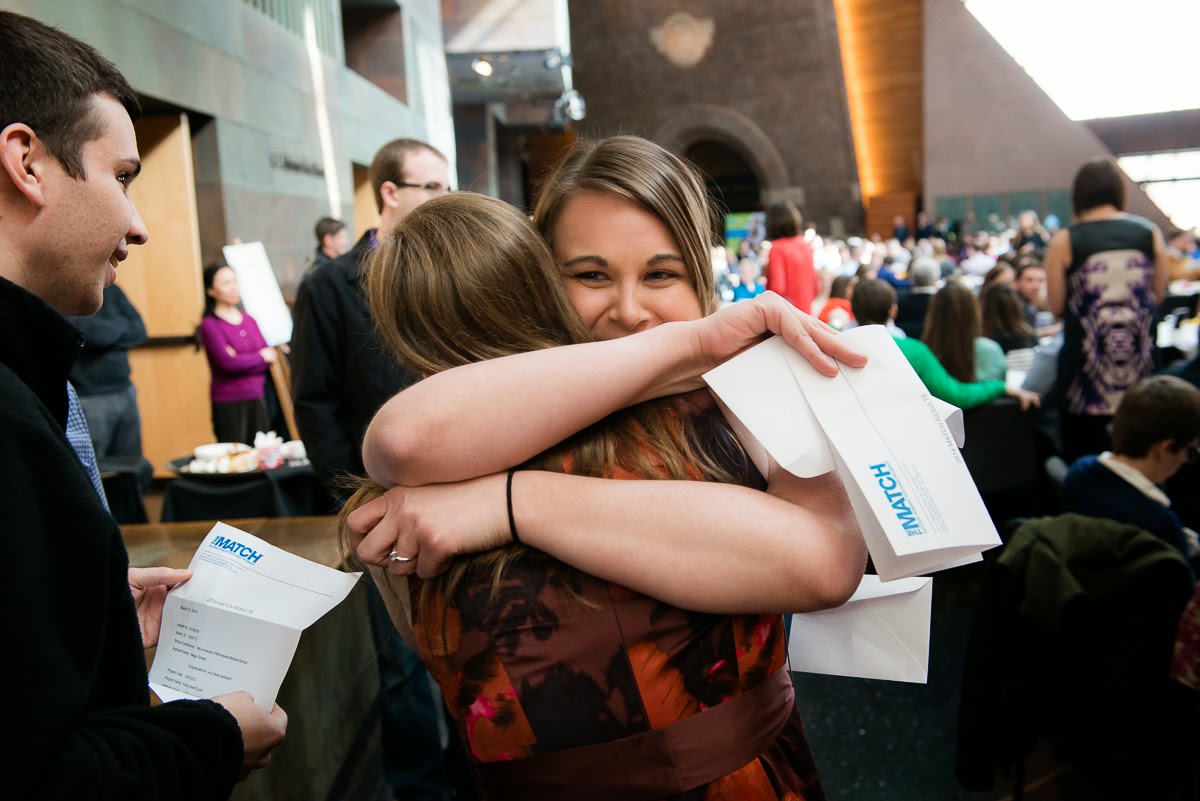
On Friday, March 18, graduating University of Minnesota medical students gathered with family and friends at McNamara Alumni Center to find out where they will begin the next phase of their careers.

Match Day is an important date shared by medical students across the country. Students receive an official letter from the National Residency Match Program (NRMP), letting them know which residency, and in what city, they will start their medical training.

We are proud to say that this year was a success for all U of M family medicine residency programs.

2016 Match Day ceremony at McNamara Alumni Center


Match Day Highlights

  • All eight U of M family medicine residency programs filled.
  •  The 2016 Match saw the most medical students and graduates matched to family medicine in the history of the specialty.
  • A record 3,105 graduating medical students across the country chose family medicine. 


University of Minnesota Family Medicine, Class of 2019


DULUTH

  • Becky Davies - Creighton University
  • Elizabeth Feist - University of Minnesota
  • Caryn Gerber - Stellenbosch University
  • Eric Hanhan - University of Minnesota
  • Joshua Kropko - Lake Erie College of Osteopathic Medicine
  • Jessica Olen - University of Minnesota
  • Steven Schumacher - University of Wisconsin
  • Jessica Stay - University of Minnesota
  • Jesse Susa - University of Minnesota 

MANKATO

  • Emily Bastyr - Des Moines University
  • Beth Brinkman - Loyola University Chicago
  • Ryan Brower - University of Wisconsin
  • Zachary Maass - Michigan State University
  • Jacob Reynolds - University of Vermont 

METHODIST 

  • Christopher Leonard - University of Minnesota
  • Elizabeth McNiven - University of California, San Francisco
  • Oluwaseun Oladokun - Poznan University of Medical Sciences
  • Chelsey Sand - Des Moines University
  • Allyson Stevenson - University of North Texas
  • Isaac Zoller - University of Minnesota

NORTH MEMORIAL

  • Christopher Childs - University of Southern Florida
  • Nathaniel Fondell - University of Minnesota
  • Alexandra Gits - Eastern Virginia Medical School
  • Kari Halvorson - University of South Dakota
  • Theang Ho - University of Iowa
  • Priya Nagarajan - Lake Erie College of Osteopathic Medicine
  • Mark Nelson - University of Minnesota
  • Samantha Ngaw - Eastern Virginia Medical School
  • Lonzale Ramsey, JR - Howard University
  • Jessica Wilson - State University of New York 

ST. CLOUD

  • John Hokanson - University of Minnesota
  • Brittany Kirkeby - Lake Erie College of Osteopathic Medicine
  • Leesa Larson - Ross University
  • John Tronnes - University of North Dakota
  • Sujitha Yadlapati - Kasturba Medical College Mangalore

ST. JOHN'S

  • Kyrstin Ball - Lake Erie College of Osteopathic Medicine
  • Donald Fahey-Ahrndt - University of Minnesota
  • Lorelli Lewis - Loma Linda University
  • Tony Huy Nguyen - University of Minnesota
  • Heidi Nichol - University of Minnesota
  • Molly Nustad - University of Minnesota 

 ST. JOSEPH'S

  • Leah Duvor - Des Moines University
  • Abigail Elliott - University of Minnesota
  • Robyn Hegland - University of Minnesota
  • Katie Hinderaker - University of Minnesota
  • Brandon Ng - University of Minnesota
  • Lindsay Schroeder - A.T. Still University of Health Sciences
  • Jaimi Weber - Des Moines University
  • Lindsay Williams - Creighton University 

UNIVERSITY OF MINNESOTA MEDICAL CENTER

  • Baheer Ashna - Windsor University School of Medicine
  • Marshall Clyde - American University of Antigua
  • Nicole Kilby - Rowan University School of Osteopathic Medicine
  • Sharondeep Toor - St. George's University
  • Yana Torres - Universidad de Ciencias Medicas Sancti Spiritus
  • David Peter - St. George's University 


Congratulations to all--we cannot wait to see what the future holds for our incoming family medicine residents.

Welcome, Class of 2019!


Friday, March 20, 2015

U of M Family Medicine Match Results 2015

It's the first day of spring AND NRMP Match Day 2015 —  the energy and excitement is palpable!

Andrew Morris-Singer, MD, of Primary Care Progress, shared a great blog post today. He asked students to remember that Match Day is not the arrival point, it's the launching point. Here's an excerpt: 
"This moment presents an enormous opportunity. ...You are in an incredible position to make an unbelievable difference. So bring yourself – all of yourself, your ideas, your skills – to the residencies and practices you’ve been matched to. Ride the wave of support for primary care – be a leader, engage new teams, and find better ways of getting patients the care they need." 

U of M Family Medicine Stats


The results are in: 

  • All eight U of M family medicine residency programs filled. 
  • Nearly 17% of U of M medical students matched into family medicine. 
  • Of the U of M medical students entering a family medicine residency, 43% are staying in Minnesota. More than 75% of that group will be going into one of our eight programs. 

Our incoming residents hail from the following schools:

  • About 25% U of M.
  • Close to 30% osteopathic.
  • About 30% allopathic from U.S. or Canada, not including U of M.
  • About 15% international.

U of M Family Medicine, Class of 2018


Duluth: 
Kristin Comstock, Charles Hackett, Benjamin Head, Kristie Johnson, Brittni McLam, Melody Shepherd, Cristina Wheeler Castillo, Dimitriy Yezhikov

Mankato:
Andrew Bader, William Bensen, Sarah Dryden, Robert Heilig, Lu Ji

Methodist: 
Judith Boylan, Ashley Davenport, Jesse Klingelhoets, Nicole Sagen, Joshua Scheck, Stephen Schwartz

North Memorial: 
Jodi Blustin, Megan Cain, Huiying Guo, Catherine Hansen, Minelva Nanton, Eneniziaogochukwu Okocha, Melissa Pavek, Nouchee Vang, Lauren Williams, Emily Wolff

St. Cloud:
Olufunke Ajayi, Jacelyn Davidson, Jamie Finke, Elina Lipovskiy, Esayas Okubamichael

St. John's:
Erica Bowen, Paul Dixon, Gregory Hannabas, Thomas Haroldson, Jennifer Svendsen, Justine Trumm

St. Joseph's:
Lindsay Arnett, Darren Cuevas, William Hoang, Paige Nelson, Thuy Nguyen-Tran, Matthew Runde, David Shrake, Daniel Smith

UMMC: 
Elizabeth Alam, Jennifer Brown, Kriti Choudhary, Andrea Larson, Nzube Okonkwo, Alexandra Tsvilina

We couldn't be more excited about our incoming class — a group of passionate students, ready to make a difference in family medicine and primary care.

Welcome, class of 2018!

Friday, March 21, 2014

How To Be Successful in The Match

Every Match Day, a number of medical schools claim that far greater numbers of students are going into primary care than actually are because the schools’ calculations don’t account for the many who match into internal medicine who will ultimately subspecialize and never practice primary care.

Still, some are truly training large numbers of primary care doctors. University of Minnesota Medical School – Duluth campus faculty Jim Boulger, PhD, shares his views on the topic in this opinion piece.


"How To Be Successful in the Match" was originally shared by Primary Care Progress and later published in the University of Minnesota Family Medicine and Community Health newsletter.


Jim Boulger, PhD

By Jim Boulger, PhD


The University of Minnesota Medical School – Duluth campus affirms within its mission statement that our goal is to train excellent family physicians that will serve rural and Native American populations. We are very successful at these tasks.  

Why?

It begins, as we all would expect, with selection. If the wrong folks come in, the wrong folks go out. We actively select applicants who are from smaller communities and have a demonstrated interest in family medicine; have been academically successful; and hold decent MCAT scores. When we interview these folks, we try to be as holistic as possible, respecting their uniqueness but always with the institutional mission “fit” in mind.

Duluth campus medical students—all of them—are required to participate in our Rural Medical Scholars Program. This means spending about five weeks in smaller communities, some as far as 300 miles away, over the first two years of medical school. While in these communities, most students move in with a family physician and his or her family. They are required to perform community assessments, but the majority of their time is spent seeing patients. Additionally, in the first year they spend seven mornings or afternoons in the offices of family doctors in the Duluth area. Many of the students also enroll in the Rural Physician Associate Program, which is a nine-month elective training experience placing each in a rural community during their third year of medical school.

Teasing apart the potency of the various components, e.g., admissions, curricular emphases, etc., is very difficult; but, I do think that it is clear the combination really works well. Of course, not all students elect family medicine as a specialty or end up in rural or Native American practice sites. Education should – and does – change us. So students may come in on the family or rural medicine track, but that doesn’t guarantee they will all leave that way. Still, we can boast that we are wonderfully successful.

Of the 1,748 students who have matriculated in Duluth since 1976, 836 have selected family medicine as their specialty. Forty-four percent of those in practice are in communities of 20,000 or less.

Many will protest that this cannot be done elsewhere. But I usually try to distinguish between what can be done and what we really want to have happen. Our behavior is more important than our pledges. If we wish to change the mix at the end of medical school—at Match time—we have to change what happens at admissions and during the medical school years. Doing the same thing again and again, but expecting different results, is one definition of psychopathology. We know that if we want to see real change in health, we must see change in lifestyle. If we want to see change in who populates our practices of medicine in the future, we must change how we function in academia. The same old stuff will not work.

Our nation needs change from us. We can make the changes necessary. But do we have the will to act? I don’t think we can wait much longer for the answer.

Jim Boulger, PhD, has been involved with medical education on the University of Minnesota – Duluth campus for more than 40 years.