Showing posts with label #UMNproud. Show all posts

Tuesday, June 12, 2018

2018 Resident and Fellow Commencement

On Tuesday, June 5, 2018, we celebrated a group of 64 extraordinary residents and fellows at the University of Minnesota Family Medicine and Community Health’s annual commencement. Held at McNamara Alumni Center on a warm summer evening, the ceremony was a wonderful opportunity to honor the graduating class as they embark on the careers ahead of them.
James Pacala stands at a podium and addresses a room full of people sitting at tables
Department Head James Pacala, MD, MS, addresses graduates

This year’s graduating class included:
  • 52 family medicine residents from our eight programs 
  • 3 pharmacy residents
  • 1 primary care behavioral health fellow 
  • 3 hospice and palliative medicine fellows 
  • 3 human sexuality fellows 
  • 2 sports medicine fellows 
  • 16 faculty and fellows who completed Teaching, Evaluation, and Curriculum for Healthcare Professionals, also known as TEACH 
  • 7 faculty who completed the Collaboration and Scholarship Intensive for Family Medicine (CSI-FM) program 
For a taste of what the evening was like, read our live tweets from the ceremony using the hashtag #umnfamilymedgrad on Twitter and view photos on Facebook.

Resident and Faculty Awards

After opening remarks by Department Head James Pacala, MD, MS, in which he encouraged graduates to consider their “role as an ambassador for an almost 50-year legacy of excellence,” several graduates and faculty were honored for excellence in teaching, research, and service.


Excellence in Research Award


Dr. Bader smiles and holds his award plaque
The Excellence in Research Award was presented to Mankato’s graduating resident Andrew R. Bader, DO, for his impressive commitment to clinical scholarship. Dr. Bader was unanimously nominated by his program’s faculty, who described him as the “embodiment of the scientist-practitioner model.” What’s more, Dr. Bader amassed an impressive six peer-reviewed publications during his three-year residency - the highest publication rate of all residents across the department’s 8 programs.

[Dr. Bader] clearly recognizes that the practice of medicine becomes stagnant if not for ongoing clinical inquiry and scholarly investigation.
- award nominator

Leonard P. Burke, MD, Memorial Award
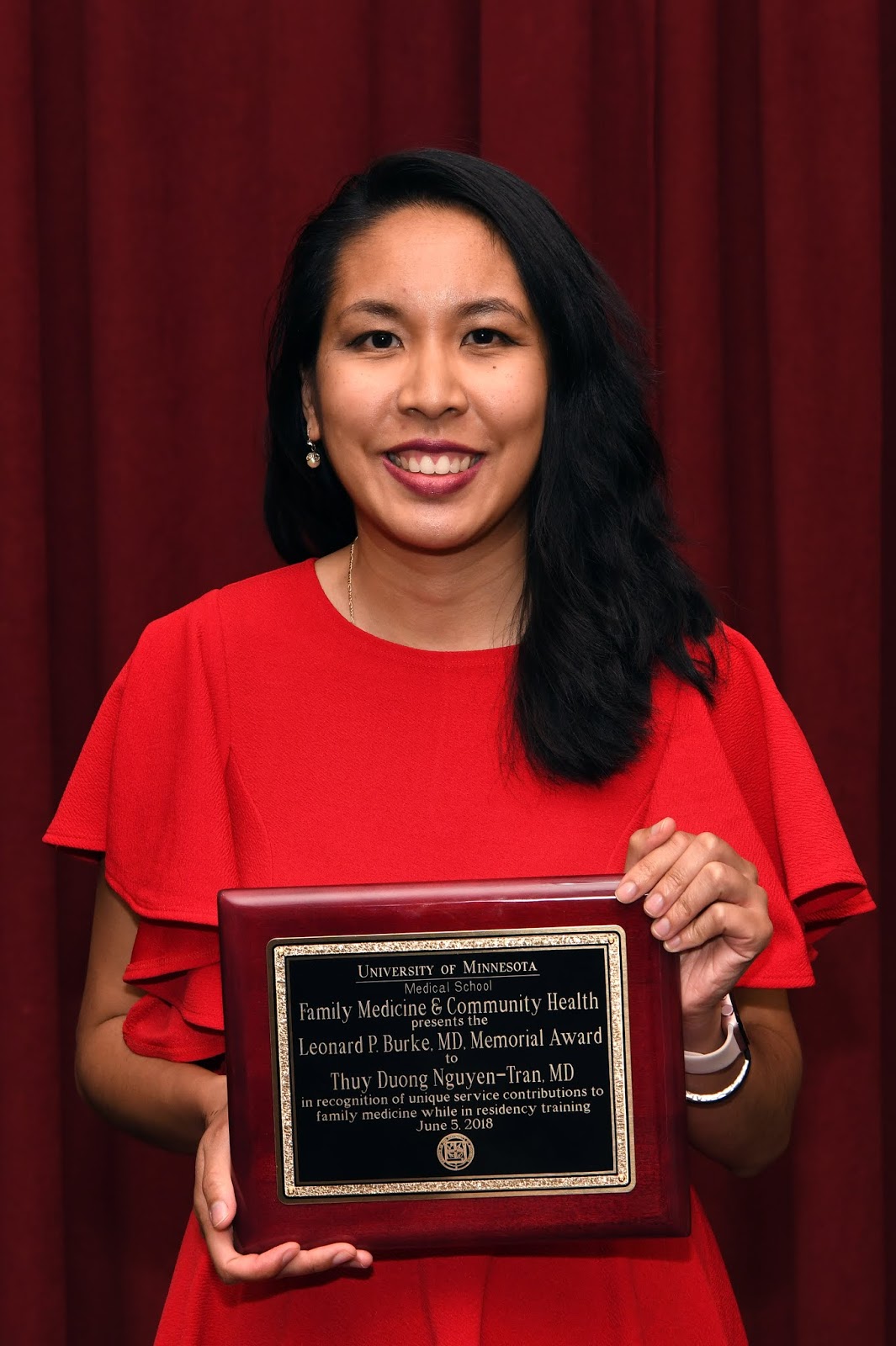
Dr. Nguyen-Tran smiles and holds her award plaque Graduating St. Joseph’s resident Thuy Duong Nguyen-Tran, MD, was presented this year’s Leonard P. Burke, MD, Memorial Award in honor of her unique service contributions to family medicine. Dr. Nguyen-Tran has been involved in several important projects at Bethesda Clinic that focus on increased community engagement and access to care for patients, especially Karen patients. In addition to serving as co-chief resident, she demonstrated excellent leadership and initiative in helping the clinic provide culturally competent care and develop multiple community partnerships.

[Dr. Nguyen-Tran] is hard working, enthusiastic, and welcoming, and she highlights the positive in every situation.
- award nominator

Faculty Awards

This year’s Affiliate Faculty Teacher of the Year went to Sandra Coffin, MD, (pictured below left) from St. Joseph’s. Nominees described Dr. Coffin’s passion and commitment to teaching, saying, “Often times, Friday afternoons can be one of the more challenging clinic days, but St. Joseph’s family medicine residents look forward to Fridays because they know Dr. Sandra Coffin will be precepting.”

Mankato faculty Erin Westfall, DO, (pictured below right) accepted the Faculty Teacher of the Year Award. As one nominee said, “Dr. Westfall has also taught me about the social responsibilities a great physician demonstrates…Dr. Westfall’s efforts show that it isn’t just about health in our clinic building – it’s about the health of our entire community that truly matters.”

Dr. Coffin smiles and holds her award plaque Dr. Westfall smiles and holds her award plaque

STFM Resident Teacher Awards

Ten residents received the Society of Teachers of Family Medicine (STFM) Resident Teacher Award for demonstrated interest, ability, and commitment to family medicine. Awardees include Duluth residency graduate Charles S. Hackett, MD; Mankato residency graduates William Bensen, DO and Andrew R. Bader, DO; Methodist residency graduate Joshua Edward Scheck, MD; North Memorial residency graduate Melissa Pavek, MD; St. Cloud residency graduate Elina Lipovskiy, DO; St. John’s residency graduate Jennifer Svendsen, MD; St. Joseph’s residency graduates Daniel Smith, DO and Thuy D. Nguyen-Tran, MD; and University of Minnesota Medical Center residency graduate Alexandra Tsvilina, MD, PhD.
A group of ten smiling award winners hold their plaques

Congratulations to all graduates and award recipients!

Save the date for next year’s commencement: June 4, 2019

Tuesday, November 7, 2017

2017 UMN Family Medicine Residency Grads: By the Numbers


In 2017, 57 medical residents graduated from University of Minnesota family medicine residency programs. An update on where those graduates are practicing or pursuing additional training follows.


Practice/Training Locations

Our graduates are currently practicing or pursuing additional training in the following locations.

  • 45 (79%) - Stayed in Minnesota
  • 5 - Went West (Alaska, Arizona, California, Nevada, and Washington)
  • 4 - Went to other Midwestern states (Indiana, South Dakota, Wisconsin)
  • 1 - Went East (New Jersey) 
  • 1 - Went South (Florida)
  • 1 - Went to Canada

Of our 57 graduates, one went to a sports medicine fellowship and three went into academic/faculty positions.

All other graduates pursued roles that were in community health service, hospital-based or private practice with health systems, medical centers, and clinics.


Tuesday, January 24, 2017

2016 UMN Family Medicine Residency Grads: By the Numbers

In 2016, 55 medical residents graduated from University of Minnesota family medicine residency programs. An update on where those graduates are practicing or pursuing additional training follows.

Practice/Training Locations

Our graduates are currently practicing or pursuing additional training in the following locations.

  • 36 (65%) - Stayed in Minnesota
  • 9 (16%) - Stayed in Midwest
  • 4 - Went West (Colorado, Oregon, and Nevada)
  • 3 - Went East (Ohio, South Carolina, and New Hampshire) 
  • 2 - Went out of the country (Zambia and New Zealand)
  • 1 - Went South (Texas)

Of our 55 graduates, four of them went into fellowship programs in sports medicine (2), hospice and palliative medicine (1), and sleep medicine (1).

All other graduates pursued roles that were either hospital-based or private practice with health systems, medical centers, and clinics.

Wednesday, January 11, 2017

Students Design Oberstar's Hip Injection Trainer

From left to right are project advisor Adam Choe, MS,
student Trevor Laughlin, project sponsor Jennifer Oberstar, MD,
students Nathan Stob, Daniel Sherman, and Rachael Brandt.
Jennifer Oberstar, MD, offered University of Minnesota senior mechanical engineering students to design a hip simulator as a way to teach learners how to do ultrasound-guided hip injections. The project was proposed in Fall 2016 to undergraduate students in the capstone senior engineering design course where teams of four to six students work for one semester on an engineering design project that’s sponsored by a local company or UMN researcher. Students then present their projects at the course’s Design Show at the end of the semester.

The students who worked on the hip simulator were Dan Sherman, Nathon Stob, Rachael Brandt, and Trevor Laughlin. Oberstar was the sponsor of the project, and Adam Choe, MS, from the University of Minnesota Medical Devices Center, was the project advisor.

“I thought the students produced an excellent prototype in the three months provided,” Oberstar said. “At the start of the project, the students were unfamiliar with the procedure and how to use ultrasound. They worked well as a team and were thoughtful with their design.”

The hip injection trainer project was offered to students because it required engineering knowledge and was an opportunity for a “real world” application. Projects with “real world” applications are more engaging for learners, and Oberstar also saw that this was an opportunity to collaborate across disciplines.

According to Oberstar, the prototype will now be introduced to experts performing ultrasound-guided hip injections. Further research will be conducted to validate the prototype. Adjustments to the current device may occur after input from faculty and learners.

The Hip Injection Trainer was funded by the Department of Family Medicine and Community Health Discovery Fund. Oberstar received funding in 2016 to develop training for family medicine residents to further hone their skills in ultrasound-guided hip injections.

HOW IT WORKS

Injection site

The injection site was created with low-hardness silicone and tactile mutilator additives to create a medium that looks and feels like human tissue when injecting under ultrasound.

In addition, each injection site contains a conductive textile, which signals the boundary of the target injection area.

Body

The lower body of the hip injection trainer contains two injectable hips molded into moderately hardened silicone.

The upper body is composed of lower-hardness silicone with the same approximate density as human muscle tissue.

Feedback system

The electronic feedback system of the hip injection trainer contains a red light-emitting diode (LED) and green LED, signaling a failed or successful injection, respectively.

A learner injects the injection site, and when passing through the conductive textile located in the bottom of the injection site, a circuit is completed, signaling a successful injection. However, no LEDs are lit until the learner depresses the plunger on the needle, signaling a finished injection.

From left to right are students Trevor Laughlin, Rachael Brandt, Daniel Sherman, and Nathan Stob.

Friday, August 5, 2016

AAFP National Conference 2016 Recap

This year’s American Academy of Family Physicians (AAFP) National Conference of Family Medicine Residents and Medical Students was held on July 28 through July 30 in Kansas City, Missouri. The conference gives medical students an opportunity to attend workshops, network, and gain insights into family medicine.


Our faculty, residents, and staff went as exhibitors to promote our residency programs. We also sponsored scholarships for medical students to attend and learn more about family medicine.


This year’s conference drew a record number of attendees with 1,210 residents and 1,349 medical students from across the nation. From the University of Minnesota, 46 medical students attended the conference. Below is a list of all U of M family medicine residency program representatives.


Duluth
Mankato third-year resident Jared Colvert, DO and program director John McCabe, MD
  • Kristin Comstock, MD, second-year resident
  • Charles Hackett, MD, second-year resident
  • E. Tolga Hanhan, MD, first-year resident
  • John Wood, MD, associate program director


Mankato
  • Jared Colvert, DO, third-year resident
  • John McCabe, MD, program director


Methodist
  • Jesse Klingelhoets, MD, second-year resident
  • Josh Scheck, MD, second-year resident
  • Stephen Schwartz, MD, second-year resident
  • Left to right: North Memorial faculty Laura Miller, MD, second-year resident
     Lauren Williams, MD, first-year resident Nat Fondell, MD, faculty Renee Crichlow, MD,
     and third-year resident Meredith Bourne, MD
  • Jeremy Springer, MD, program director


North Memorial
  • Meredith Bourne, MD, third-year resident
  • Reneé Crichlow, MD, faculty 
  • Nat Fondell, MD, first-year resident
  • Laura Miller, MD, faculty
  • Lauren Williams, MD, second-year resident (MAFP-sponsored)


St. Cloud
  • Dennis Peterson, MD, faculty
  • 
Noah Retka, MD, third-year resident


St. John’s
St. Cloud faculty Dennis Peterson, MD, and third-year resident Noah Retka, MD
  • Bobby Kagigebi, MD, third-year resident

  • Kaitlyn Schoeck, MD, third-year resident

  • Angela Smithson, MD, MPH, program director
  • 
Jennifer Svendsen, MD, second-year resident


St. Joseph’s
  • Robert Hlavacek, DO, third-year resident

  • Manuel Idrogo, MD, faculty

  • Michael Nasenbeny, MD, third-year resident

  • Margaret Perko, MD, third-year resident


University of Minnesota Medical Center

  • Andrea Larson, DO, second-year resident

  • Carrie Link, MD, faculty
  • Raquel Van Norman, administrator


Department Staff
  • Tanner Nissly, DO, faculty advisor for the Family Medicine Interest Group (FMIG) on the Twin Cities campus and North Memorial faculty

  • Laura Pham, residency programs coordinator

  • Nkauj Shoua Vang, communications specialist

Social Media

The traveling Loon trophy
For the third year in a row, we held a friendly social media challenge between our eight residency programs. For the challenge, we specifically tracked Twitter usage using #aafpnc. The residency program and individual who tweeted the most using #aafpnc received prizes. 


This year’s winning team was our Methodist program, with a grand total of 359 tweets. They will receive the traveling Loon trophy (our version of the Twitter bird.) This year's individual winner was second-year Methodist resident Jesse Klingelhoets, MD, with a total of 189 tweets. He wins a $30.00 gift card to the University of Minnesota Bookstore.


Methodist program director Jeremy Springer, MD, with second-year residents Jesse Klingelhoets, MD, Josh Scheck, MD, and Steve Schwartz, MD.

Past winners:
2015: Program winner: North Memorial; Individual winner: Carrie link, MD, University of Minnesota Medical Center
2014: Program winner: North Memorial; Individual winner: Reneé Crichlow, MD, North Memorial

In addition to sponsoring a social media challenge on Twitter, we used the new Facebook Live feature to introduce our programs and encourage attendees to stop by program booths. Click here to see the videos. If you were unable to attend this year’s conference, you can view photos from our exhibit here.


We look forward to next year’s conference, which will be held on July 27 through July 29, 2017.

Medical students visiting with our program representatives

Thursday, July 7, 2016

Mpls. St.Paul Magazine 2016 Top Doctors

Mpls. St. Paul Magazine released its 20th annual list of Top Doctors in the Twin Cities this month. We are proud to announce that a number of University of Minnesota Family Medicine and Community Health faculty were named in the specialties of family medicine, geriatrics, and sports medicine.

Metro area physicians and registered nurses were asked to nominate one or more doctors whom they would choose if they or a loved one were seeking medical care. Candidates who made the final list were grouped into 42 specialties and evaluated on a variety of factors, such as peer recognition, professional achievement, and disciplinary history. The highest scoring doctors were then invited to serve on a blue-ribbon panel and asked to evaluate candidates in their practice area. Physicians who acquired the highest total points from the survey, research, and blue-ribbon panel review were named to the Mpls. St.Paul Magazine 2016 Top Doctors list.

Congratulations to the following faculty who were named 2016 Top Doctors:

July cover of Mpls. St.Paul Magazine

Family Medicine

Patricia Adam, MD, MSPH
Sharon Allen, MD, PhD
Nancy Baker, MD
Nicole Chaisson, MD, MPH
Jon Hallberg, MD
Kara Pacala, MD
Shailey Prasad, MD, MPH
Christopher Reif, MD, MPH
Jamie Santilli, MD
Jeremy Springer, MD
Carolyn Torkelson, MD, MS
Mary Wagner, MD

Geriatrics 

Michael Dunkinfield, MD
Teresa McCarthy, MD, MS
James Pacala, MD, MS

Sports Medicine

Robert Johnson, MD
David Olson, MD
Steven Stovitz, MD, MS

Click here to view
the complete list of Top Doctors
.

Wednesday, June 22, 2016

Welcome, Class of 2019!

U of M, Class of 2019

On Friday, June 17, University of Minnesota Family Medicine and Community Health department head Macaran Baird, MD, MS, welcomed 54 new residents at orientation. Below is a message to the class of 2019 from Dr. Baird.  

Welcome everyone,

We are thrilled that you are beginning your story in family medicine with us.

Our goal here at the University of Minnesota is to deliver on the promise of family medicine.

What does that mean? 
• We want to be a leader in training family physicians for Minnesota and beyond.
• We want to improve the health of underserved communities and populations.
• We want to drive research in health disparities and healthcare delivery.
• And, most importantly, we want to ensure quality care for the whole person.

This is a big promise, and it takes energetic, talented, dedicated people like you to make it happen. We are counting on you to help transform the field of family medicine. You are the future of this ever-changing field. A strong primary care workforce is a big part of the solution to America’s health problems, and you are leading the innovation and transformation in primary care.

Here at the U of M, you will work along side many talented people, not just family physicians. You will work with pharmacists, therapists of different kinds, social workers, medical assistants, care coordinators, and more. The teams that you will work with have many more components than they did some years ago. These teams need your passion, your energy, and your intellect.

We will also be learning from you. You raise questions and do things that teach us while we teach you. Because of your ideas and questions, faculty learn faster. If we are teachers, we need to learn at a faster rate than we would in traditional practice. Many of our faculty continue teaching because of you and the questions and ideas you bring.

Some of you may be familiar with the Triple Aim in primary care – enhancing patient experience, improving health, and reducing costs. Over the past few years, the Triple Aim has expanded to the Quadruple Aim, making the experience enjoyable for not only the patient, but also the provider—you.

We often forget about making the provider’s experience more enjoyable, but if you force someone to get things done, it doesn’t work. They become dispirited or dismayed about their work role and do not put forth their best ideas. They lose energy, not gain it, and the system gradually fails. It is important to take care of yourself and each other—the system works better if you are feeling reasonably managed, taken care of, and supported in your endeavors.

If you want to affirm the patient in front of you, help them feel capable enough to get through the next day despite the odds they are facing, you have to feel that way too.

On an easy day, you might be able to offer your smile, courtesy, or just decentness to a patient. But, on a tough day, feeling under supported, you might do something less accommodating to the patient, and you may walk away feeling worse, no matter the problem.

You can affirm people everyday by simply being the kind of person that you are now. Don’t let us take that part of you away. You’ve got it now, and if it starts to shrink, talk to us! Almost all of us hit the wall every now and then, but I want you to always remember that we are here for you. We support you. You matter to us.

Residency is the start of a new chapter in your lives. The next three years will be challenging, rewarding, and fun.
I look forward to watching you all grow as family physicians.
University of Minnesota Family Medicine and Community Health department head Macaran Baird, MD, MS

Friday, April 22, 2016

MAFP Spring Refresher 2016 Recap


The MAFP Spring Refresher is an annual family medicine conference for family physicians, family medicine residents, medical students, and allied health professionals. The conference covers updates in medical knowledge, skills workshops, clinical practice improvements and innovations, and more. It's also a great opportunity for Minnesota-based family physicians to connect with colleagues from across the state.


A number of our residents and faculty were in attendance at this year's conference. Several gave presentations, including Reneé Crichlow, MD, on burnout prevention and mindful meditation; Barbara Elliot, PhD, MDiv, on end-of-life decision making; Nancy Baker, MD, on the use of mobile devices in medicine; Mary Wagner, MD, on clinician resilience.

Also among presenters was Kim Nagel, an undergraduate research assistant working with research faculty Alicia Allen, PhD. She presented on recruiting and retaining smokers in research studies.

View their presentations here.

What drives you to practice or teach family medicine?

Department faculty Reneé Crichlow, MD
We had a great time in the Exhibit Hall visiting with current and former faculty and residents, community physicians, and University of Minnesota medical students. 

We asked attendees to answer the following question--“What drives you to practice or teach family medicine?” This question corresponds to this year’s University of Minnesota marketing campaign, “We are the Driven.”


We took photos of our visitors with their answers on a chalkboard and posted the photos to our social media channels. See photos here.


MAFP Honors and Awards

Several department faculty and residents were also honored at the conference for contributions to family medicine education and research.


2016 MAFP Teacher of the Year 
Carrie Link, MDUniversity of Minnesota Medical Center faculty
Carrie Link, MD


2016 Resident of the Year
Elizabeth Lownik, MD, MPH, U of M North Memorial Family Medicine Residency Program
Elizabeth Lownik, MD, MPH


Also among awardees was fourth-year University of Minnesota medical student Mark Nelson, who won the Medical Student Award for Contributions to Family Medicine.
Fourth-year U of M medical student Mark Nelson


In addition to being a medical student, Mark is a Julliard alumnus who has been performing with Hippocrates Cafe, since its first show. Mark will continue his career in medicine with the University of Minnesota North Memorial Family Medicine Residency Program.

Last, but not least, department head Macaran Baird, MD, MS, won the “Most School Spirit” award and faculty David Power, MD, MPH, won the "Most Shocking" award for participating in MAFP’s Sunglasses Selfies Contest.
Department head Macaran, Baird, MD, MS
Department faculty David Power, MD, MPH


Congratulations to all who received an award!

Looking Ahead

The MAFP Spring Refresher is an annual event that happens in the spring for Minnesota family physicians. For more information and next year's schedule, visit the MAFP website.

Thursday, February 18, 2016

Report from Cape Town: Family Medicine in South Africa

David Power, MD, MPH
The following blog post was written by University of Minnesota Family Medicine and Community Health medical student education director David Power, MD, MPH. Power is on a single semester leave at the University of Cape Town School of Public Health and Family Medicine in South Africa. He is teaching medical students and residents, consulting on curriculum, and making connections for University of Minnesota students to study abroad in family medicine. 

Report from Cape Town, South Africa

Written by: David Power, MD, MPH

I am midway through my single semester sabbatical. It has been a full, busy, interesting, disconcerting, warm, but generally fun time so far. Cape Town has been very welcoming. I’ve been given my own small office. They stand on ceremony here more than in the United States; since I am a full professor, they call me “Prof Power.” My host Derek Hellenberg, MBChB, and clerkship director Nazlie Beckett, MBChB, have included me on site visits to the community health clinics where students are placed. In general, students here are given less responsibility in patient care than at our clinics in the United States.

Office at the University of Cape Town

Family Medicine and Public Health Integration


At the University of Cape Town, family medicine is a division in the School of Public Health and Family Medicine, which is quite interesting for me given my appointment as integration leader of public health and health policy in the University of Minnesota Medical School. 

The dean here at Cape Town has asked me to present to the school on the integration of family medicine and public health, which is causing me a little anxiety as I prepare! I’ll also be presenting to educators on the results of the multi-institutional study I was involved in that explored mental health and the impact of burnout on medical students. My intention with both of these presentations is to generate a healthy discussion so that the learning goes both ways.

Family Medicine Residency (or Registrarship)


Left to right: Derek Hellenberg, MBChB,
 Nazlie Beckett, MBChB, and David Power, MD, MPH
Family medicine residency (called a registrarship here) is a relatively new field in this area, first recognized in 2007. There is no residency clinic. Registrars get assigned to hospitals and community clinics on a rotating basis. One of the recruitment challenges is that after six years of medical school, everyone is required to complete two years of internship and one year of community service. Family medicine (and other specialties) are then required an additional four years after that. Hence, the majority of physicians who want to work in primary care do not pursue residency once they have completed their three years of service. 

The internship is designed to enable all physicians to be able to practice independently in a rural hospital—so at the end of it, they should be competent to administer anesthetics, perform cesarean sections, as well as manage acute and chronic diseases. It seems that many of those who do elect to sign up for family medicine residency are either interested in administrative training or in leaving the country, since Canada recognizes training here as equivalent to their own.

The long-term goal in South Africa is that family physicians will be the ones managing the health of entire regions, several with populations of more than a million. They will also manage the budget for that region and distribute funds to specialists and allied health providers—quite the tall order. 

I will be doing site visits to observe registrars in action and provide formative feedback using the Patient Centered Assessment Method (PCAM) tool. I will also encourage registrars to develop individual learning goals.


Cape Town Medical School


The Cape Town medical school is considered one of the premier schools in sub-Saharan Africa. It has taken the lead in promoting multiculturalism and presently 70% of students are female and less than 40% are white—quite the change from 20 years ago. 

Family medicine runs a required course over almost all six years of medical school, teaching students to speak medical Afrikaans and medical isiXhosa (Xhosa). Both of these languages are the primary languages of many Cape Town residents; a desire to provide patient-centered care in the patients' preferred languages is what drives this curriculum.

David Power, MD, MPH, University of Cape Town ID

I hadn’t realized how much of an icon Christiaan Barnard, MD, is in Cape Town. There is a museum here celebrating the first successful heart transplant, which he performed in 1967. Did you know that he started as a general practitioner and received his cardiac surgery training under Walt Lillihei, MD, PhD, during a two-year fellowship at the University of Minnesota?

I’ve enjoyed spending time with Steve Reid, MBChB, MFamMed, PhD. Reid is a family physician and professor at the University of Cape Town. He runs the rural longitudinal clerkship and a multi-disciplinary course in health, the arts, and humanism. I will sit in on Steve’s humanism course when it starts in a few weeks and hope to write with him about the legacy of Christiaan Barnard, MD. Steve and an anthropologist colleague also run a Massive Open Online Course (MOOC) alongside the live course that anyone can join free. Visit https://www.futurelearn.com/courses/medicine-and-the-arts/ to sign up. Last year, more than 5,000 people worldwide participated.


Life in Cape Town


Lion's Head - Cape Town, South Africa
I can't say I'm missing the Minnesota winter! We're staying in a beautiful area. Our views each morning are of the harbor with Robben Island on one side and Lion’s Headpart of the dominating Table Mountainon the other. 

Our kids have settled into the American International School of Cape Town quite well. The only minor headache is twice a week having to endure traffic jams as I drive 30 kilometers (18.6 miles) each way to pick them up from their sporting activities, which prevents them from taking the bus home. Minneapolis-St. Paul traffic has nothing on the gridlock that occurs here daily in the mornings and from about 3:00 pm to 7:00 pm.

I’ve maintained my University of Minnesota Medical School role from a distance, so I have regular Skype calls around 5:00 pm here, which is 9:00 am for you. Well, I better sign off now. I hope to share more learnings when I return. 

David Power, MD, MPH, with wife and children

Thursday, January 14, 2016

Faculty Dwenda Gjerdingen, MD, MS, Retires From the U of M Department of Family Medicine and Community Health

After more than 34 years of service, department faculty Dwenda Gjerdingen, MD, MS, retired on January 8, 2016. She was faculty in the University of Minnesota St. Joseph's Hospital Family Medicine Residency Program. Her primary interest was women’s health, and she had been active in postpartum research for more than 25 years.

The following post is a Q&A with Gjerdingen, reflecting on her time as a family medicine physician, researcher, and faculty member at the University of Minnesota. 

What roles have you held during your time here in family medicine?

  • Associate and interim director of St. Joseph’s residency, 1982-1999
  • Director of the Advanced Life Support in Obstetrics (ALSO®) course
  • Research fellow (completed MS in clinical research in 2011)
  • Researcher of women’s postpartum health 
  • Member and former chair of the Promotion and Tenure Committee
  • Educator of family medicine residents and medical students


Will you share some highlights of your research in postpartum depression?
I had the privilege of working with a great team of investigators from the UMN School of Public Health, Department of Psychiatry, and other academic and clinical institutions. We conducted a series of studies, looking at:
  • The nature and duration of postpartum recovery
  • The correlation of postpartum mental health with other variables (health, social, employment). Our research was the first to show a direct relationship between women’s postpartum mental health and their length of maternity leave.
It is exciting to see others furthering this line of research for the benefit of mothers and their families. 

What do you enjoy most about teaching residents?
Our residents are fantastic to work with—they are sharp, kind, hard-working, care about their patients, and are just nice people. What more could you want?

What are your favorite memories from your time here in family medicine?
Years (no, decades) ago, our residents used to go Christmas caroling in the hospital. Sometimes, the hospital staff would join us, and it was a very uplifting, delightful experience, enjoyed by all. I suppose there are all kinds of rules against this today, but the shared music really seemed to build good will, and the harmonies were beautiful!

My more recent favorite memories are the conversations that we have in our precepting room at the clinic. Everyone chimes in—medical students, residents, faculty, PharmDs, psychotherapists—and, it is not uncommon for the entire room to end up laughing together over some silly story.

What are your plans for retirement?
I hope to spend more time with my husband and family, perhaps travel, enjoy walking, reading, cooking, playing piano, volunteering at church. I have a special interest in wellness (nutrition and exercise), so I am hoping that I might contribute to some community wellness initiative. 

Do you have anything else you would like to share?
I will greatly miss the people I’ve had a chance to work with, those at our residency program, in other affiliated programs, and within our central department. Wow, I have so many good memories. Thanks everyone!


Gjerdingen, (front row, far right) with a group of
family medicine residents from the 1970s

Friday, November 6, 2015

Celebrating U of M Family Medicine and Community Health

On October 29, 2015, an evening was dedicated to honoring the history of the University of Minnesota Department of Family Medicine and Community Health and looking to our future and the future of family medicine.


Launching the Discovery Fund

It was also our first philanthropic event with the launch of the U of M Family Medicine and Community Health Discovery Fund. The fund was set up to pilot innovations in family medicine. More specifically, to support early stage ideas, creative research, and scholarly projects (from within our department) that advance the art and science of family medicine. Our target fundraising goal is $100,000. So far, more than $15,500 has been raised.


Honoring Our History, Building Our Future

More than 200 people attended the October event at the McNamara Alumni Center on the Minneapolis campus, including current and retired faculty and staff, current residents and fellows, alumni, colleagues from the U of M Medical School, community partners, and more. Guests had the opportunity to enjoy drinks, share conversation, take fun photos, look through historical information, watch a performance by Hippocrates Cafe, and support our vision for delivering on the promise of family medicine.

Performer T. Mychael Rambo sings, "Make Them Hear You."

Family Medicine Through Story and Song

Hippocrates Cafe, which is created, directed, and hosted by family medicine faculty Jon Hallberg, MD, performed its 80th show at our celebration. The show explored both the history of family medicine and the history our department through story and song. Highlights included a riveting performance of "Make Them Hear You," from Ragtime, sung by T. Mychael Rambo, and the premiere of our video, "Delivering on the Promise of Family Medicine."


Advancing Family Medicine

The launch of the U of M Family Medicine and Community Health Discovery Fund is just the beginning of our renewed focus and commitment to advancing our specialty. The department has four areas of focus, referred to as our cornerstones:

  • Promote core principles and values of family medicine, ensuring care for the whole person.
  • Be a leader in training family physicians for Minnesota and beyond.
  • Improve the health of underserved communities and populations.
  • Drive research in health disparities, healthcare delivery, and population health.

Be Part of Our Future

Department head Macaran Baird, MD, MS, closed the night by saying, "All of you have been a part of our history, and we are inviting you to be a part of our future. We are a strong department, and with your help, we will get stronger."

Baird, "With your help, we will get stronger."